
When the technology stops, what happens to the people?


For most of us, technology is so embedded into the working day that we barely notice it.
We open Outlook. Jump on Teams. Find a document in SharePoint. Send someone a message. Join another call. And probably do all of those things before we’ve finished our first cup of coffee.
So, when the technology suddenly stops working, things can get interesting.
The recent Microsoft outage was a timely reminder of just how much modern organisations depend on technology. So much of the way we work is built around systems that we rarely stop to think about, until suddenly they’re not there.
But perhaps the more interesting question is what happens to the people when the technology stops working?
Turns out, people quite like an unexpected day off
First, we should probably acknowledge one of the less scientific findings from the outage.
Judging by the reaction online, there were at least a few people wondering whether Outlook going down meant it was acceptable to quietly close the laptop and take a break.
But underneath the jokes was something genuinely interesting.
Over the past few years, our working lives have become increasingly digital. Conversations have moved online. Corridors have become Teams channels. Documents live in SharePoint. Email underpins much of our day-to-day communication.
Take those familiar tools away and suddenly we have to ask: Where do I find that information? How do I contact that person? Can we still make this decision? Does anybody remember an actual phone number?
And: what do we do next?
The internet did what the internet does best
Another thing became clear pretty quickly. When the unexpected happens, people have a very good sense of humour.
Within no time, social media was filling up with memes.
Of course, technology outages can have serious consequences, particularly for organisations delivering critical services. So this isn’t about making light of that.
But humour gives people a way to connect over a shared experience. It can break tension, build a sense that we’re all dealing with this together, and gives us a little bit of perspective.
And on that note, here are a few of our favourites from the day...
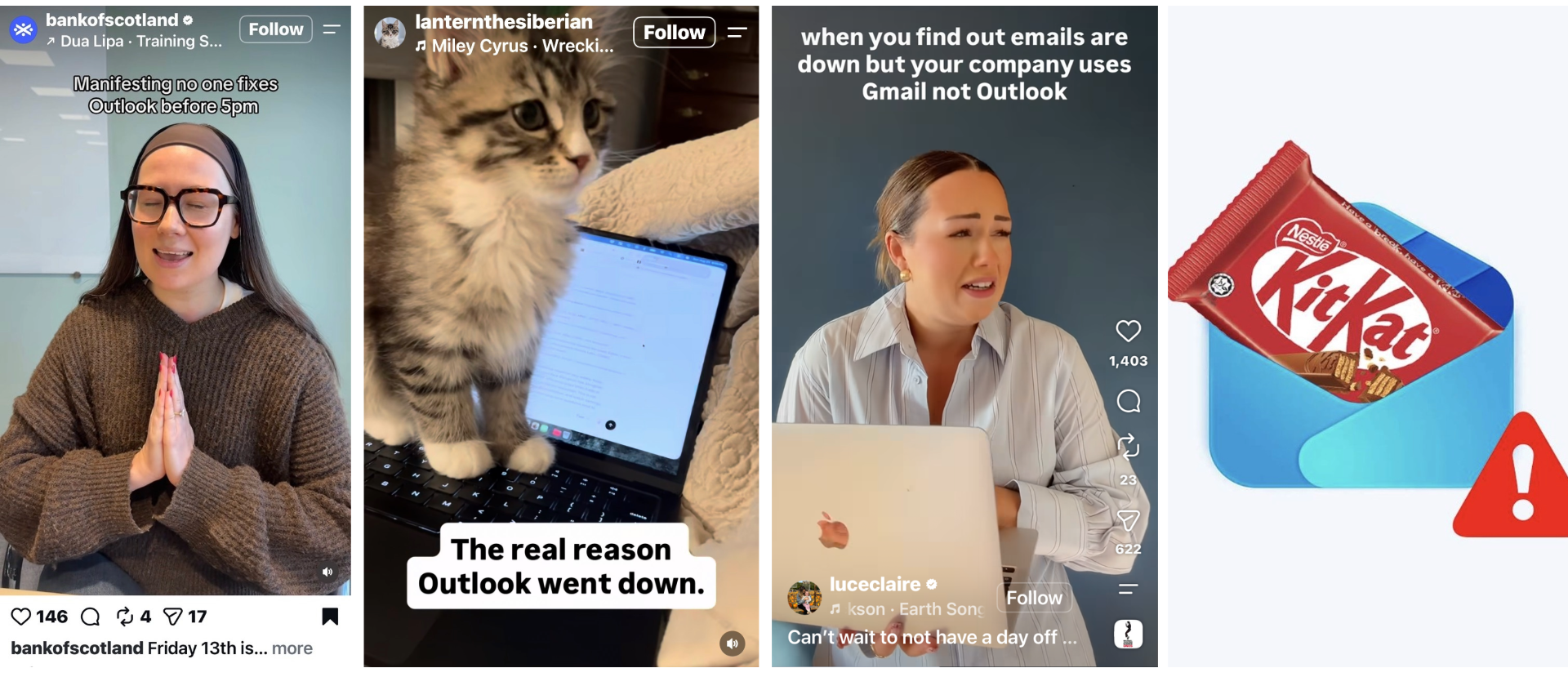
Credit to the creators at Bank of Scotland, Lucy Claire, Lantern the Siberian, and KitKat Malaysia
Memes aside, there's a useful lesson here.
Resilience isn’t just about having a backup system
When organisations think about resilience, attention naturally goes to technology: contingency planning, infrastructure, security, backup systems and business continuity.
All essential.
But there’s another side that can be easier to overlook: people resilience.
Do people have the confidence to adapt when familiar tools aren’t available? Can they find another way to collaborate? Do they understand the processes behind the technology rather than simply knowing which buttons to press?
These aren’t really technology questions. They’re questions about skills, confidence, culture and change.
Change readiness matters, even when the change wasn’t planned
We often talk about change in the context of major transformation: a Microsoft 365 migration, a new way of working or a Copilot rollout.
But change doesn’t always arrive neatly packaged in a project plan. Sometimes it’s unexpected. Sometimes it’s temporary. And sometimes it exposes gaps we hadn’t previously recognised.
That’s why adaptability matters.
People who feel confident with technology are better placed to problem-solve when something changes. Organisations that encourage continuous learning are more likely to have people who can find another route when the usual one isn’t available.
And as AI accelerates the pace of workplace change - building confidence, capability and adaptability across your organisation matters more than ever.
So, what did we learn?
Systems come back online. Emails eventually arrive. And before long, everyone is back to business as usual.
But moments like this give organisations a chance to ask:
Are we building digital skills, or simply teaching people how to use individual applications?
And are our people genuinely comfortable navigating change?
At Hable, we’ve always believed that successful digital transformation isn’t simply about implementing technology. It’s about enabling people to understand it, embrace it and make the most of it.
Because technology will change. Sometimes it will fail.
And occasionally, we get an unexpected break from the day-to-day and a reason to smile 😉
Ready for Change?
We help businesses like yours embrace change, accelerate innovation and transform culture. Get in touch today to start your transformation journey.
