
Nobody got emotional about SharePoint. (100% written by a human)


(100% written by a human)
AI is an emotive topic. People are wired for feeling first and thinking second. We know that change triggers emotion - it's just how we are built – and it’s therefore completely natural that we react emotionally when the world shifts around us. I’ve been in the change business for 12 years – so why does AI adoption just feel different?
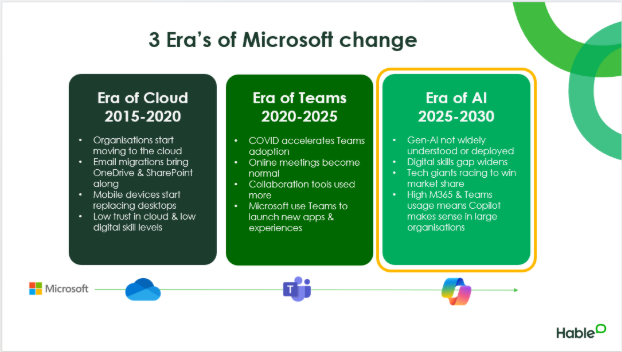
Since 2015, Hable has been through three major, distinct eras of technology change.
The first five years were all about customers making their first move into the cloud. Our customers were doing e-mail migrations and document migrations – moving their files into OneDrive and SharePoint. Some people were sceptical about the security of moving data to the cloud, but the benefits it brought and the modern interfaces it delivered, meant that it was a no-brainer for most organisations. Fundamentally, nobody got emotional about SharePoint.
(Well, maybe a few IT Managers I’ve met over the years, but let’s not go there)
The next era we went through with our customers (from say 2020 to 2025) was the era of remote working or the era of Microsoft Teams. Now of course a lot of what happened in this era and the change it drove in people's behaviours was driven by the COVID-19 lockdowns. That was a very emotional time for people, but the emotion was driven by the fear of what was happening in the outside world – not by what was happening on the desktop. And ultimately, most of us had very little choice about whether or not we wanted to adopt the technology that was now vital to keep our organisations running.
Now we’re in our third era – the era of AI. Let's say for the sake of argument that this era of AI will be 2025 to 2030 – giving us our 3 distinct eras of Microsoft technology being adopted at scale by large organisations and people having to adapt and learn to work in new ways.
The key to good technology adoption and good change management is making sure everybody in the organisation comes along with you on the journey. You have to meet people where they are, and you have to speak in a language that they will respond to – and we’ve learnt many lessons over our 12 years in business about how to do that effectively. It’s not about spinning a story, it’s about explaining benefits rather than features – and conveying a genuine belief that technology can be a force for good in the world.
But internal comms and the art of taking people “on a journey” in the era of AI feels different, and in some ways that's no surprise.
You only have to turn on the news or scroll through your social media feed to see posts about the impact that AI is having and may have in the future on our lives. Everyone is trying to figure out what it means, both inside and outside the workplace. And I don’t know about you – but to me, it feels like nobody has really cracked it yet.
So we have to accept that people are coming into the conversation about workplace AI carrying a lot of preconceptions and a lot of emotion. And that's why you have to do a better job of leading your people through this era: because people are emotional about this topic.
Broadly speaking, our experience suggests that people fall into three groups:
- The excited. Some of your staff are already on board and need to have their excitement nurtured. Get them to be your pathfinders. Train them on Copilot Cowork or Studio and set them to work building agents and solving real business problems.
- The cautious. In my mind, these are the people that have not yet had the lightbulb moment. They’re using Copilot to take some meeting notes, or to edit an email – but they’re not convinced it can have a meaningful impact on the quality of what they produce or save them time to spend on things which only humans can do.
- The resistant. Then there are the people who are actively resistant. Maybe the're not saying it out loud, but they have genuine fears about the future of work, the environmental impact – and even the future of humanity itself.
Some leaders are talking to all 3 groups in the same way. That won’t work. And if you only focus on the “excited” cohort – your digital divide will grow and you will never get maximum ROI from your investment in Copilot.
You arguably should be working harder on groups 2 and 3, than you are on group 1. If you want AI adoption to succeed, you can't ignore the emotion. Yes, those conversations are harder – but nobody said that change was easy...
Ready for Change?
We help businesses like yours embrace change, accelerate innovation and transform culture. Get in touch today to start your transformation journey.
