
How to Choose an AI Adoption Partner: A Guide for Enterprise and Public-Sector Leaders

AI investment is accelerating. But for many large organisations, the harder question is no longer how to introduce AI. It is how to turn that investment into measurable business value.
Employees may have access to Microsoft 365 Copilot and other AI tools. Pilots may be underway, leadership teams may be enthusiastic, and the technology may be working exactly as intended. Yet everyday working practices often remain largely unchanged.
The gap between deploying AI and embedding it into the way an organisation operates is where the real challenge begins.
For CIOs, IT Directors and digital workplace leaders, this creates an important decision: how do you choose an AI adoption partner that can turn technical implementation into lasting organisational change?
The answer lies in looking beyond technology expertise. The right partner must understand how people work, how change happens at enterprise scale, and how to build the confidence, capability and internal momentum needed to realise value from AI over time.
At Hable, we have spent more than a decade helping organisations put people at the heart of technology change. Drawing on that experience, here are the key factors UK enterprise and public-sector leaders should consider when choosing an AI adoption partner.
1. Look beyond AI implementation to lasting adoption
AI implementation and AI adoption are closely connected, but they are not the same thing.
Implementation focuses on making the technology available. It includes licences, configuration, security controls, data readiness and technical deployment.
Adoption is what happens next. It is the point at which people understand what AI can do, trust it enough to use it appropriately, and begin incorporating it into the tasks and decisions that matter.
This distinction is important because a successful technical rollout does not automatically deliver business value.
An organisation might deploy Microsoft 365 Copilot successfully, complete a pilot and provide access to thousands of employees. But if people lack the confidence to use it, struggle to identify relevant use cases or revert to familiar working practices, the investment may never achieve its potential.
The latest Office for National Statistics data shows that self-reported AI use among UK businesses rose rapidly from around 12% in late 2023 to 35% in June 2026. Yet adoption remains relatively shallow: among businesses using AI, only 10% reported using it extensively.[ons.gov.uk] For IT and transformation leaders, the implication is clear: deployment is the starting point, not the outcome.
Lasting AI adoption requires more than a technology rollout. It needs a business change programme that connects the technology with people, processes and measurable outcomes.
A capable AI adoption partner should help you move beyond deployment milestones towards sustained use. That means understanding how work gets done today, identifying where AI can make a meaningful difference, supporting employees as their working practices evolve, and measuring whether those changes deliver results.
When evaluating potential partners, ask one question first:
Can you demonstrate how you have helped an organisation move from an AI pilot to sustained adoption at scale?
Look for evidence of what changed for employees and the organisation, not just what technology was deployed.
2. Choose an AI change management partner equipped for enterprise complexity
Change management is often discussed as though it were a straightforward communications exercise. In practice, effective enterprise change requires much more.
A launch announcement can create awareness. Training sessions can introduce new capabilities. Neither guarantees that people will change their behaviour or continue using AI once the initial excitement fades.
At enterprise scale, adoption is rarely uniform. Different business functions, locations and professional groups will have different priorities, levels of digital confidence and attitudes towards AI. Some employees will be ready to experiment; others will need more support to understand how AI fits into their role.
A successful AI adoption programme must account for these differences rather than assume a single approach will work for everyone.
Research from the Department for Science, Innovation and Technology (DSIT), highlights the gap between organisations' use of AI and their readiness to scale it. Only a third of organisations planning to adopt AI felt ready to implement it, and just over half of those already using AI felt ready to scale it. Limited skills and expertise were among the recurring barriers identified in the research. [gov.uk]
This is why a structured approach to AI change management matters. It should bring together leadership alignment, employee engagement, learning, governance and ongoing measurement within a coherent programme.
At Hable, our change management practice draws on Prosci foundations and combines structured frameworks with practical, people-centred delivery. Our Digital Maturity Assessment establishes a baseline by identifying existing behaviours, confidence levels and capability gaps.
That evidence provides a more useful starting point than assumptions about how ready the workforce is to adopt AI. It also provides a benchmark against which an organisation can evaluate and demonstrate meaningful adoption at a later date.
When assessing a prospective partner, ask:
- How will you assess our organisational readiness before the programme begins?
- How will you adapt the approach for different roles, teams and levels of confidence?
- How will you involve leaders and managers in reinforcing new ways of working?
- How will you measure progress beyond licence activation and attendance at training?
The strongest partners will explain how these elements work together, how they respond when adoption stalls, and how they sustain momentum after launch.
3. Insist on learning that reflects real work, not just AI features
One of the biggest barriers to AI adoption is the gap between understanding what a tool can do and knowing how to use it effectively in a particular role.
A generic demonstration might show employees how to summarise a document or generate a response. Role-based learning goes further. It helps a finance manager explore how AI could support reporting, or a project lead understand how it might help prepare stakeholder updates.
The difference is relevance.
When employees can see how AI relates to their responsibilities, they have a clearer reason to experiment, practise and incorporate it into their routines. Learning becomes a practical enabler of better work rather than another course to complete.
This is particularly important in large organisations, where employees will have different starting points. Some may already be confident digital users who want to explore more advanced applications. Others may need foundational guidance, opportunities to practise and reassurance about using AI responsibly.
An effective AI adoption partner should design learning around those needs.
At Hable, we focus on tailored, scenario-based learning that meets people where they are and builds from there. Rather than delivering the same content to every employee, the aim is to connect AI capabilities to relevant tasks, responsibilities and working practices.
But learning should not end when a workshop finishes.
Sustained adoption requires opportunities to revisit skills, discover new use cases and build confidence as the technology evolves. Resources for continued learning, practical follow-up and Digital Champion networks can all help keep that progress moving.
When choosing a partner, look for a learning strategy that continues beyond the initial rollout and can demonstrate how it builds capability over time.
4. Build internal capability instead of long-term dependency
A successful AI adoption partner will help your organisation become better equipped to manage change independently.
This is an important consideration for leaders who need to scale adoption across business units, maintain governance and respond to a technology landscape that will continue to evolve.
If every new use case, learning requirement or adoption challenge requires external support, the organisation risks becoming dependent on its partner rather than developing its own capability.
Digital Champions can help address this challenge. These colleagues provide visible, peer-led support within teams, helping employees explore relevant use cases, share practical experience and build confidence in their day-to-day work.
However, a champion network needs more than a list of volunteers. Champions need clear responsibilities, appropriate training, ongoing support and a connection to the wider adoption programme. Their role should complement leadership, management and formal learning rather than replace them.
A good partner will stay engaged with your organisation for the long term, and also plan for knowledge transfer and the gradual handover of ownership to internal teams.
The objective is to establish the skills, resources and structures that enable your organisation to continue learning and adapting long after the original engagement ends.
5. Prioritise Microsoft 365 and sector expertise that fits your organisation
AI adoption does not happen in isolation. It takes place within your existing technology environment, business processes, governance arrangements and organisational culture.
For organisations using Microsoft 365, choosing a partner with relevant platform expertise can make a meaningful difference.
Understanding Microsoft 365 Copilot means more than knowing its features. It means understanding how Copilot interacts with the wider Microsoft 365 environment, including Teams and SharePoint, and how employees use these tools to communicate, collaborate and manage information.
That context helps a partner identify practical use cases, understand potential barriers and design learning around the way work already happens.
Sector experience is equally important. A public sector organisation, university, healthcare provider and commercial enterprise may face very different workforce, accessibility, governance and budgetary constraints.
A partner that understands these differences is better placed to adapt its approach to the organisation rather than apply a standard programme regardless of context.
Hable specialises in Microsoft 365 and AI adoption, with experience across UK enterprise, public sector, healthcare and education organisations. Our focus is on helping organisations embed technology into everyday working practices through people-centred change and learning.
When evaluating a partner's experience, ask for evidence from organisations with challenges comparable to your own.
A useful case study should explain the starting point, the approach taken, the challenges encountered and the outcomes achieved. A list of technologies, services or client names is not enough to establish whether a partner can deliver the change you need.
6. Measure AI adoption by business outcomes, not activity alone
For senior IT leaders, the ultimate test of an AI adoption programme is not how much the technology is being used, but whether it is delivering meaningful value.
Licence activation, login frequency and training attendance are useful indicators, but they do not show whether people are working differently or whether the organisation is seeing a return on its investment.
This distinction becomes increasingly important as AI programmes move beyond pilots. McKinsey's 2026 State of AI research found that while 80% of respondents using AI in their roles said it improved their individual productivity, only 37% reported a positive contribution to organisational EBIT. [mckinsey.com] Meanwhile, Gartner reports that just 13% of CIOs say their organisation has realised significant or transformational value from AI so far. [gartner.com]
For IT and transformation leaders, the message is simple: define success before implementation and measure it throughout the adoption journey.
At Hable, we look at adoption through five interconnected pillars, informed by Prosci's research into the human and organisational conditions that support successful AI adoption:
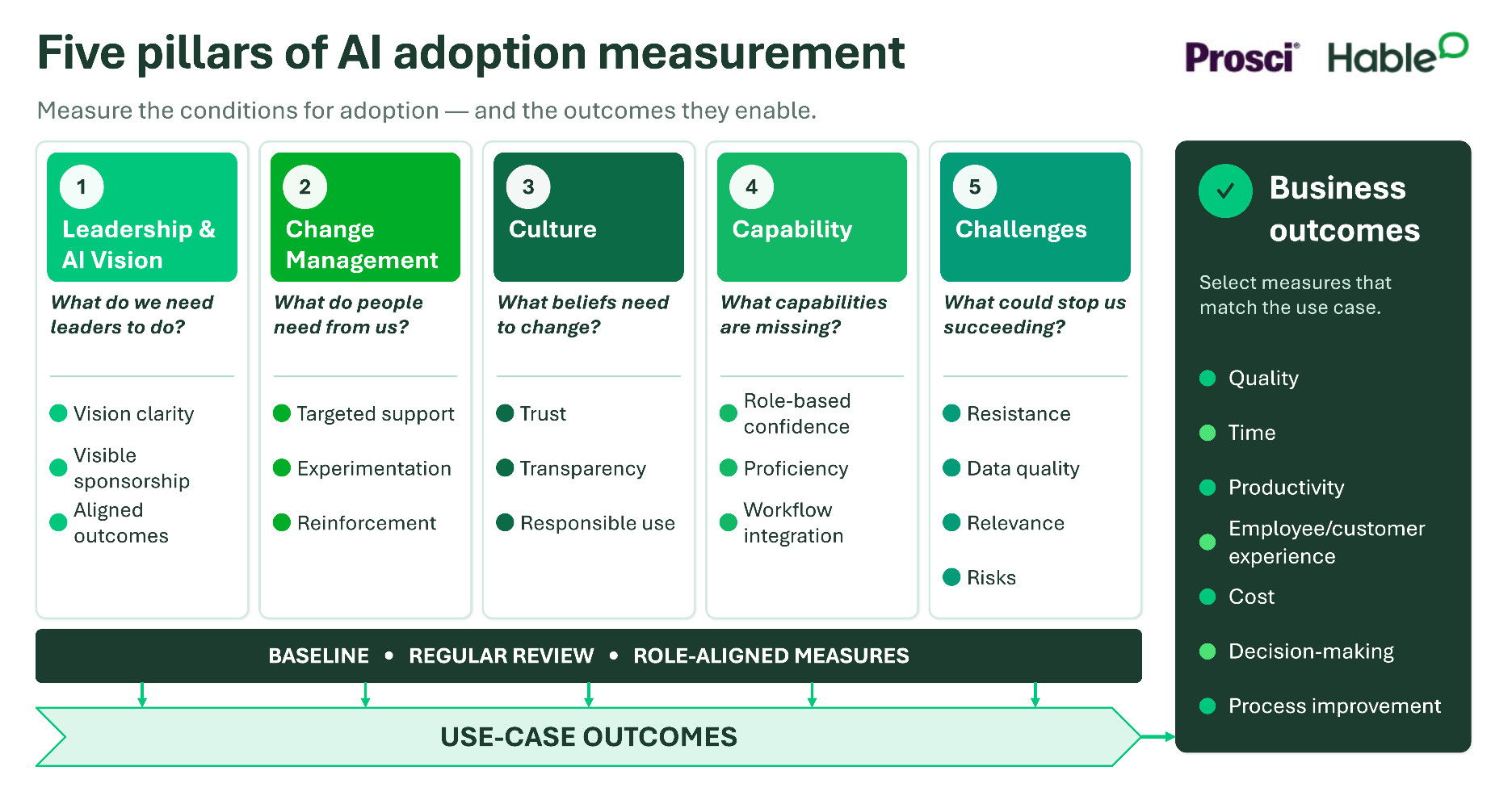
Leadership & AI Vision - What do we need leaders to do?
Is there a clear vision for AI, connected to organisational priorities and visibly supported by leaders? Measure whether people understand that direction and whether leadership behaviour reinforces it.
Change Management – What do people need from us?
Are people receiving the communication, support and opportunities to experiment, that they need to change how they work? Look beyond training attendance to whether new behaviours are actually being adopted and sustained.
Culture – What beliefs need to change?
Do employees trust the organisation's approach to AI and understand how to use it responsibly? Confidence, transparency and willingness to experiment are important indicators of whether adoption can take hold.
Capability – What capabilities are missing?
Are people developing the role-specific skills and judgement needed to use AI effectively? Measure whether employees can identify relevant use cases, evaluate outputs and apply AI confidently within real workflows.
Challenges – What could stop us succeeding?
What barriers are limiting adoption? These might include resistance, poor data quality, lack of relevance, low trust or unclear governance. The important measure is whether those barriers are being understood and reduced over time.
These pillars help organisations understand whether the conditions for adoption are improving. They should then be connected to the outcomes each AI use case is intended to deliver.
Those outcomes will vary. Depending on the use case, organisations might measure time saved, productivity, quality, employee or customer experience, cost, decision-making or process improvement. Prosci's research suggests that successful AI implementations take this multidimensional approach rather than relying on a single measure of success.
What matters is establishing a baseline, defining the intended outcomes and reviewing progress consistently. Usage data still has a role, but it should be treated as evidence of activity rather than evidence of value.
A strong AI adoption partner will help you connect the two: understanding whether people are adopting new ways of working and whether those changes are delivering meaningful business outcomes.
Choosing the right AI adoption partner for long-term value
As AI technology continues to evolve, organisations will face ongoing decisions about which capabilities to introduce, where to apply them and how to manage the resulting change.
The organisations best positioned to realise value will be those that can turn new technology into effective, sustainable working practices.
That requires more than technical implementation. It calls for structured change management, relevant learning, internal capability, platform and sector expertise, and a clear way to measure outcomes.
When selecting an AI adoption partner, look for evidence that they can:
- Lead people-centred change at enterprise scale, with a structured approach to readiness, engagement and sustained adoption.
- Translate AI capabilities into relevant everyday use cases, supported by role-based learning and practical guidance.
- Build lasting internal capability, including effective Digital Champion networks and a clear transfer of ownership.
- Apply relevant Microsoft 365 and sector expertise, tailored to your organisation's technology environment and operational constraints.
- Connect adoption to measurable business outcomes, rather than relying on licences, logins or training attendance as proxies for success.
The right partner will not simply help your organisation introduce AI. It will help your people use it with confidence, build the capability to adapt as it evolves, and create the conditions for technology investment to deliver lasting value.
How Hable can help
Hable helps organisations put people at the heart of Microsoft 365 and AI adoption. Through people-centred change management, digital maturity assessment and tailored learning, we help organisations understand their starting point, build workforce capability and support the transition towards new ways of working.
If your organisation is preparing to introduce Microsoft 365 Copilot, scale existing AI initiatives or strengthen adoption across a complex workforce, Hable can help you develop an approach grounded in your people, your priorities and the outcomes you want to achieve.
Explore Hable's approach to AI adoption and change management at Hable.co.uk.
Ready for Change?
We help businesses like yours embrace change, accelerate innovation and transform culture. Get in touch today to start your transformation journey.
